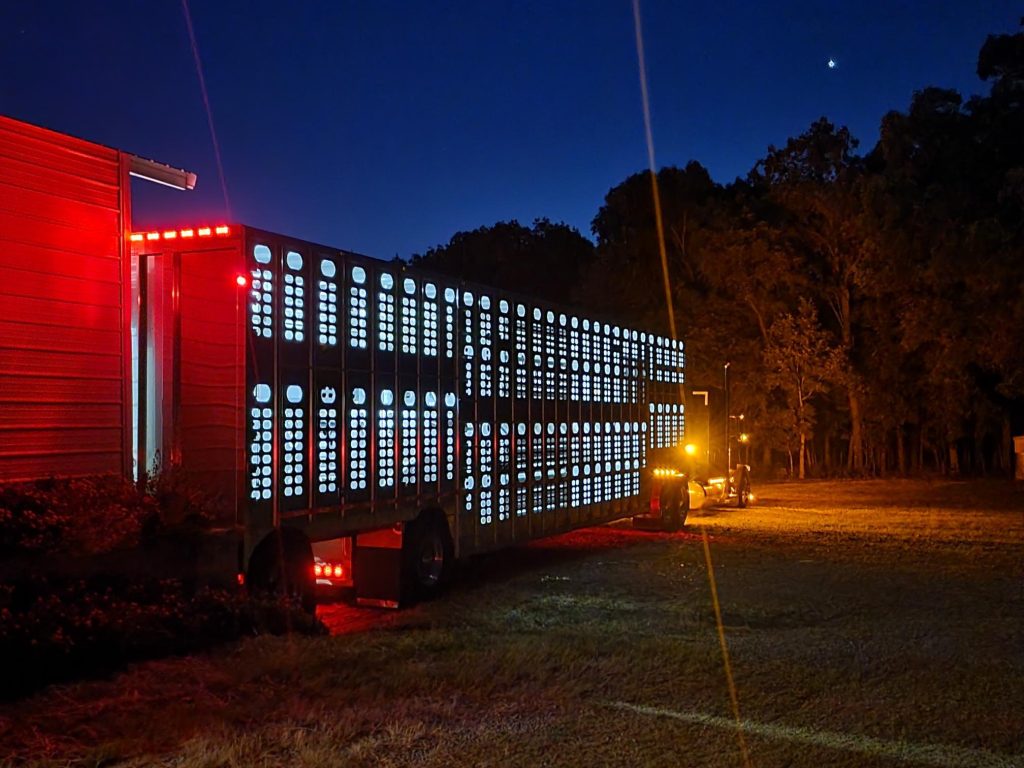
When large, integrated swine production systems were created, one unintended consequence was the simultaneous development of “fomite superhighways” along which pathogens could travel from farm to farm. Recognizing this risk, Farm Health Guardian developed the technology for swine integrators to monitor all their farm vehicles, including trucks, trailers and service vehicles.
Vehicle movements critical part of biosecurity
A major 2026 study by Galvis et al., co-authored by Gustavo Machado, provides strong scientific support for this approach. The researchers analysed more than 1.1 billion GPS records from 761 vehicle cabs and 584 trailers over 18 months and linked those movements with disease data from 6,621 U.S. swine farms. They found that each additional weekly visit by a cab that had visited a disease-positive farm one day earlier was associated with a 305% increase in the odds of PRRS positivity and a 286% increase in the odds of PED positivity.
Each additional weekly visit by a cab that had visited a disease-positive farm one day earlier was associated with a 305% increase in the odds of PRRS positivity and a 286% increase in the odds of PED positivity.
The study also found that risk was associated with both pig-transport and non-pig-transport vehicles, while greater vehicle loyalty to the same farms and cleaning and disinfection generally decreased that risk. These findings show why vehicle contact history, not simply the movement of pigs, should be incorporated into risk-based surveillance and biosecurity planning.
Not all GPS devices created equal
Having already developed the first virtual system for monitoring the movement of people to mitigate people-associated disease transmission, Farm Health Guardian turned to digitizing vehicle movement. At the time, there was little field evidence available to quantify this risk.
Real-time vehicle and trailer tracking technologies were still developing and had not been designed for biosecurity surveillance. Farm Health Guardian tested dozens of GPS tracking devices, many of which failed to meet manufacturers’ claims for battery life and reliability under harsh winter conditions.
After thorough field testing, we identified GPS devices that showed reliable performance during winter and proved reliable in daily operations related to livestock production and sanitation, with no significant impact on battery life. Many of our customers now use these devices for real-time monitoring of vehicle movements and to get alerts if company biosecurity protocols are breached, enabling them to intervene before potentially costly disease exposure occurs.
Digitizing vehicle movements leads to stronger biosecurity
Called Protocol® Truck & Trailer, Farm Health Guardian technology now monitors thousands of vehicles across the United States, Canada and the European Union, generating and analysing large volumes of movement data every minute of every day 24/7. It provides the field-proven tracking systems and analytics needed to help swine companies identify biosecurity risks, strengthen compliance and reduce the likelihood of disease spreading between farms.
Customers use Protocol Truck & Trailer for disease surveillance and mitigation, while at the same time gaining insights into opportunities to improve truck and trailer utilization, routing and scheduling.
The 2026 Galvis et al. study adds to the research confirming the value of vehicle movement monitoring like Protocol Truck & Trailer for gaining timely, actionable biosecurity insights and intelligence.
Visit Farmhealthguardian.ca for more information.
Reference
Galvis, J. A., Parker, T. B., Corzo, C. A., Ferreira, J. B., Meiklejohn, K. A., and Machado, G. (2026). Descriptive and risk analysis of vehicle movements linked to porcine reproductive and respiratory syndrome and porcine epidemic diarrhea transmission in U.S. commercial swine farms. Preventive Veterinary Medicine, 256, 106996. https://doi.org/10.1016/j.prevetmed.2026.106996
