The highly integrated nature of today’s pork production systems increases the likelihood of disease spread, which means that transport biosecurity is even more critical. One recent study reveals there are still significant gaps in this area, while another study highlights how Farm Health Guardian real-time breach alerts enhance visibility and improve transport biosecurity compliance.
Transport biosecurity gaps
A Wean-to-Harvest Biosecurity Research Program study funded by the Swine Health Information Center focused on the unloading process at the harvest plant.[1] The study tracked the presence of four major swine pathogens to assess trailer contamination during unloading.
It’s no surprise, the researchers found that the unloading area is a major hotspot for pathogen presence. “A substantial proportion of trailers were already contaminated when they arrived at the plant; however, contamination levels increased further after unloading for all viruses evaluated. This demonstrates that trailers not only bring pathogens into the facility but can also acquire additional contamination during the unloading process.”
Of the trailers that tested negative for all viruses when they arrived, nearly 75% were contaminated with at least one pathogen when they left. This means that unloading market hogs at harvest facilities is an important amplification point for disease spread and “the interaction between contaminated docks and trailers creates an ongoing cycle of contamination that can transport pathogens back to farms.”
“The interaction between contaminated docks and trailers creates an ongoing cycle of contamination that can transport pathogens back to farms.”
Based on these results, it’s safest to assume all trailers returning from harvest facilities are contaminated, underscoring the importance of thorough cleaning, disinfection and drying prior to reuse.
But this reveals a critical secondary gap in transport biosecurity, which is validation of those biosecurity requirements.
Validating transport biosecurity with technology
This is where digital biosecurity can help close the gaps. A Swine Vet Center study evaluated the effectiveness of Farm Health Guardian digital biosecurity and real-time breach alerts in enhancing visibility and improving compliance.
Farm Health Guardian software was integrated with a swine production system to monitor real-time vehicle movement and biosecurity compliance. The software was linked to the GPS of feed trucks and fleet vehicles (e.g., vehicles, maintenance trucks) servicing the wean-to-market phase of production. Geofences around each production site recorded vehicle entries and exits throughout the study period.
Biosecurity rules were configured in Farm Health Guardian to align with the production system’s biosecurity pyramid and downtime requirements. Any changes to health statuses or downtime requirements were automatically updated within the software to reflect movement restrictions.
The study was conducted in two periods: Period 1 (7 weeks) served as a baseline, and Period 2 (10 weeks) monitored vehicle movements and biosecurity breach alerts. Key data was collected was with respect to compliance with downtime and biosecurity pyramid protocols by vehicle type. Biosecurity breach alerts were categorized by type and production phase to identify high-risk patterns.
Closing the gaps
Between periods 1 and 2, median weekly downtime biosecurity breaches declined from 223 to 89 (Table 1). Feed truck breaches also declined from 94 to 38.5, while median fleet vehicle breaches declined from 129 to 50.5.
Farm Health Guardian digital biosecurity resulted in a decline of feed truck biosecurity breaches by 41%, and fleet vehicle breaches declined by 39%.
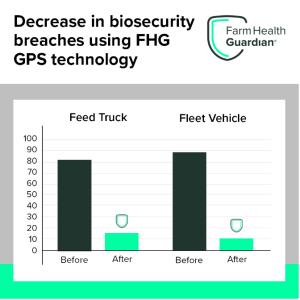
The study’s conclusion? “These findings suggest that real-time, GPS-based monitoring can enhance compliance with transport and vehicle biosecurity measures and increase awareness of the risk of breaches.”
Improving transport biosecurity won’t just happen on its own. Decisions and actions need to be intentional. Real-time feedback makes personnel more aware of their actions, leading to greater accountability when implementing protocols and improved biosecurity compliance.
[1] https://www.swinehealth.org/shic-funded-study-quantifies-trailer-contamination-risk-at-harvest-plants/
