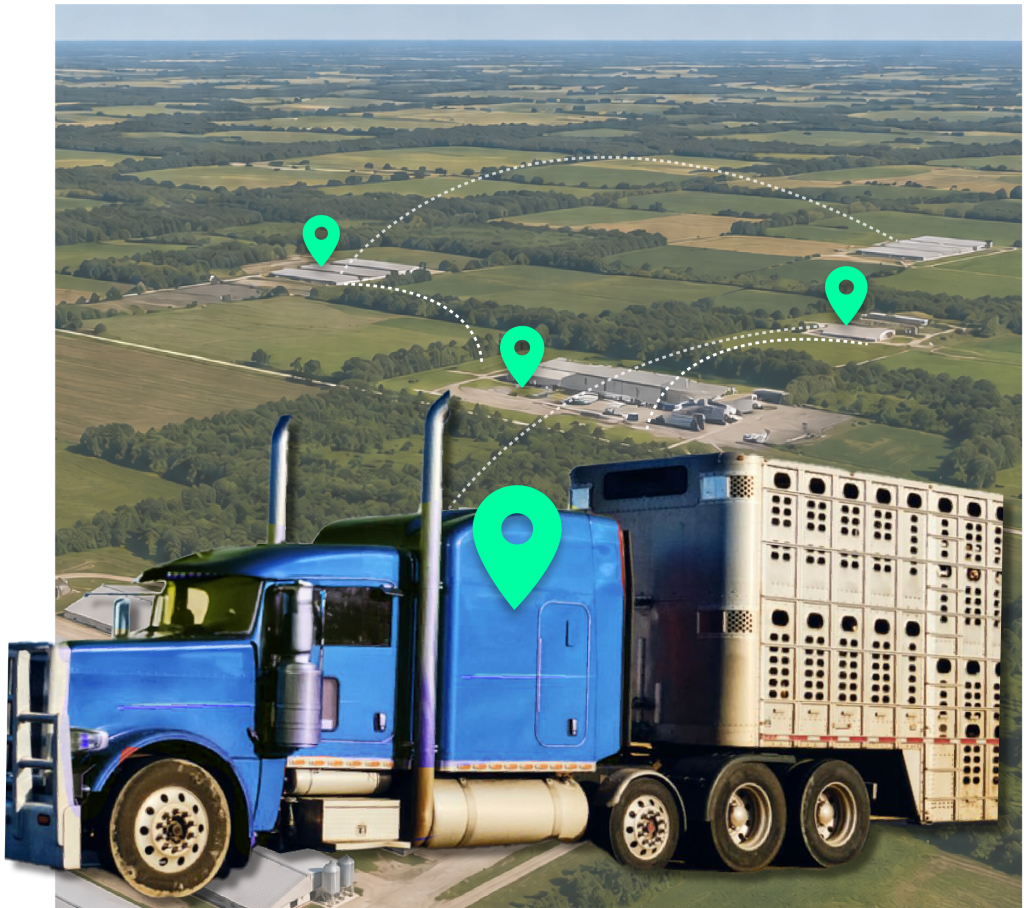
People move. Trucks move. Disease risk moves. Production systems are becoming more connected, and the ability to see, understand and respond to those movements is increasingly important. In fact, a Swine Health Information Center study found that 75% of trailers leaving harvest facilities were contaminated with at least one pathogen, even though they tested negative for all viruses on arrival.1
This means that people need to think bigger beyond their own truck fleet. A common objection to digital biosecurity is that third-party trucking companies will not share their GPS data to be part of a regional biosecurity program. It’s a legitimate concern since these companies and truck fleets operate independently and don’t necessarily see the reason to link into a customer’s biosecurity management system.
The Network Effect in Manitoba
But Manitoba (MB) is a different story. Within that province, there are 873 vehicles (trucks or trailers) connected to Farm Health Guardian software via GPS, with a total of 32,733 average monthly vehicle visits recorded to those properties. A visit is when a person or a vehicle enters one of the participating farm or agri-business properties.
Of the 873 trucks and trailers connected to the Farm Health Guardian software, 528 (60%) are third-party vehicles, such as live-haul transport companies, feed companies, and maintenance contractors. These third-party party vehicles account for nearly 7,500 visits per month or nearly 23% of the total monthly visits.
These third-party party vehicles account for nearly 7,500 visits per month or nearly 23% of the total monthly visits.
This network effect has been significant. When a high proportion of third-party trucking companies are linked to the software, there is more value in participating because their customers are asking for it.
“We caught trucks and trailers going to the wrong sites right away after launching Farm Health Guardian,” said one swine integrator veterinarian.
Going Beyond Standard Fleet Tracking
Traditional fleet tracking platforms focus primarily on vehicle location and logistics. However, Protocol® Truck & Trailer is designed specifically for livestock production systems and transport biosecurity management. The software combines vehicle movement information with transport biosecurity requirements to provide production managers, veterinarians, and biosecurity teams with greater visibility into transportation activity and compliance across their operations.
We monitor a customer’s biosecurity protocols in real-time and send breach alerts when the rules aren’t followed. This may include monitoring truck wash protocols, downtime requirements, trailer assignments, production flow requirements, and other transportation practices intended to reduce disease transmission risk.
The software compares vehicle movements against established transport biosecurity requirements and notifies designated team members in real-time when a potential breach is identified. By identifying potential breaches as they occur, teams can investigate sooner, take corrective action, and strengthen transport biosecurity compliance across the operation.
Supporting Real-Time Disease Response
As part of the MB PED (porcine epidemic diarrhea) Elimination Plan2, at the first suspicion of PED on a farm, even before laboratory confirmation, strict protocols are put in place to prevent spillover to neighboring farms. The farm is immediately locked down.
“In the event of a suspected outbreak, the app provides an immediate “audit trail” … you can instantly generate a report showing every person and vehicle that visited the affected site and where they went afterward,” says Elvin Garcia, P. Ag., Manager of Biosecurity at HyLife.
“In the event of a suspected outbreak, the app provides an immediate “audit trail” … you can instantly generate a report showing every person and vehicle that visited the affected site and where they went afterward,” says Elvin Garcia, P. Ag., Manager of Biosecurity at HyLife.
Digital biosecurity software instantly alerts all connected vehicles and people within the buffer zone who had contact with the farm (transporters, feed mills, nearby farms) to heighten their own biosecurity. The ability to immediately inform everyone helps reduce the risk of disease transmission. In addition, digital tools verify vehicle movements to ensure that no animals are moved out of the farm for four weeks.
Manitoba demonstrates what is possible when a critical mass of adoption is reached. It is a model to work towards in other regions and has enabled Farm Health Guardian to be a major contributor to regional disease control strategies, such as the successful MB PED Elimination Plan.
1 https://www.swinehealth.org/shic-funded-study-quantifies-trailer-contamination-risk-at-harvest-plants/
2 https://manitobapork.com/wp-content/uploads/2026/08/Manitoba-PED-Elimination-Plan-2026-updates.pdf
