Modern pork production systems are highly integrated with frequent (and often unpredictable) movement of people and vehicles between sites. The highly connected nature of these systems makes them vulnerable to the spread of swine diseases.[1]
It is the link between routine site movements and pathogen introduction that make effective biosecurity and timely detection of high-risk events even more critical, say Jamie Madigan, DVM and Christine Mainquist-Whigham, DVM, MS of Pillen Family Farms.[2] However, traditional biosecurity programs that rely heavily on employee compliance and manual documentation fall short in this area. Outbreak investigations done after the fact can take days to complete, allowing further disease spread.
This is where Farm Health Guardian digital biosecurity can change the game. Farm Health Guardian digitizes and automates biosecurity protocols that help veterinarians and biosecurity managers monitor compliance, identify risks, and respond quickly when issues arise.
“The platform allows for comprehensive monitoring of personnel and vehicle movements, real-time detection of biosecurity breaches, and improved compliance…”
“The biosecurity software platform allows for comprehensive monitoring of personnel and vehicle movements, real-time detection of biosecurity breaches, and improved compliance with established biosecurity policies. Real-time alerts allow non-compliant events to be addressed promptly, reducing the risk of disease transmission,” say Madigan and Pillen.[3]
The importance of human movements
It’s common knowledge that animal movement creates a risk of spreading disease through animal-to-animal contact, but the human factor is a significant gap that is often left out.
The paper, A network evaluation of human and animal movement data across multiple swine farm systems in North America, states that “While animal movement networks are used to identify disease spread risks and design response plans, human movement between farms was rarely accounted for. Human movements, when integrated with animal movement models, create a different, more inclusive, and accurate network structure when compared to animal movements alone.”[4]
Human movements are shown to be a significant factor in the transmission of diseases, such as African Swine Fever virus (ASFv) and Porcine Endemic Diarrhea virus (PEDv). Risk assessments point to human movements and product imports in the long-range transmission of ASFv between countries.[5]
Dr. Klaus Depner, Senior Scientist, Institute of International Animal Health/One Health says that “Humans are the main cause of long-distance transmission and virus introduction into pig farms,” and that “It is always human error that results in the (ASF) virus entering the barn.”[6]
Easier biosecurity is one tap away
Farm Health Guardian has two distinct apps that make biosecurity easier for people moving between multiple sites within a network.
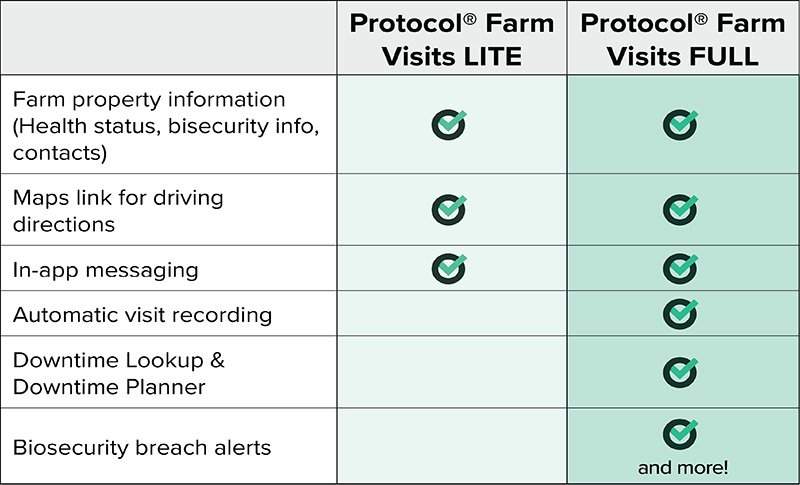
The Protocol® Farm Visits app provides quick access to downtime, pyramid and other biosecurity requirements for any geofenced property in a system. It automatically records visits to farm properties and instantly verifies if personnel meet biosecurity requirements. The app eliminates the hassle of downtime planning and gives the best route between multiple properties to meet biosecurity requirements. The Farm Visits app also reduces administrative burden and simplifies communication, so the animal health team can focus on higher-value decisions.
Not ready for visit recording?
The Farm Visits LITE app does not have geofencing and farm visit data is not collected. It is a confidential app for your system that includes latitude/longitude coordinates for farm properties and displays driving directions with a Google or Apple maps link. The app provides biosecurity information, health status and key contacts for all farm properties in your system, all in one place, one tap away.
When people know what is required before they arrive, they are more likely to follow requirements consistently.
Tools that make it easy to do the right thing protect the people in the system as much as they protect the herd. Today’s highly integrated pork production systems need to make biosecurity practices more consistent, easier to follow, and faster to communicate. That’s exactly what Farm Health Guardian delivers. Visit farmhealthguardian.com to learn more.
[2] Montenegro, M., & Manabat, A. (2023). Challenges to the successful control of ASF in the Philippines: a swine practitioners view [Conference Session]. 2023 Allen D. Leman Swine Conference, Saint Paul, MN, USA. https://lemanconference.umn.edu.
[3] Ibid
[4] https://farmhealthguardian.com/increasing-disease-pressure-emphasizes-need-for-strong-biosecurity/
[5] https://www.swinehealth.org/shic-funded-project-examines-growing-pig-site-biosecurity-gaps/
[6] https://farmhealthguardian.com/wp-content/uploads/2026/02/Dr.-Jaime-Matigan_AASV-paper-2026.pdf
